


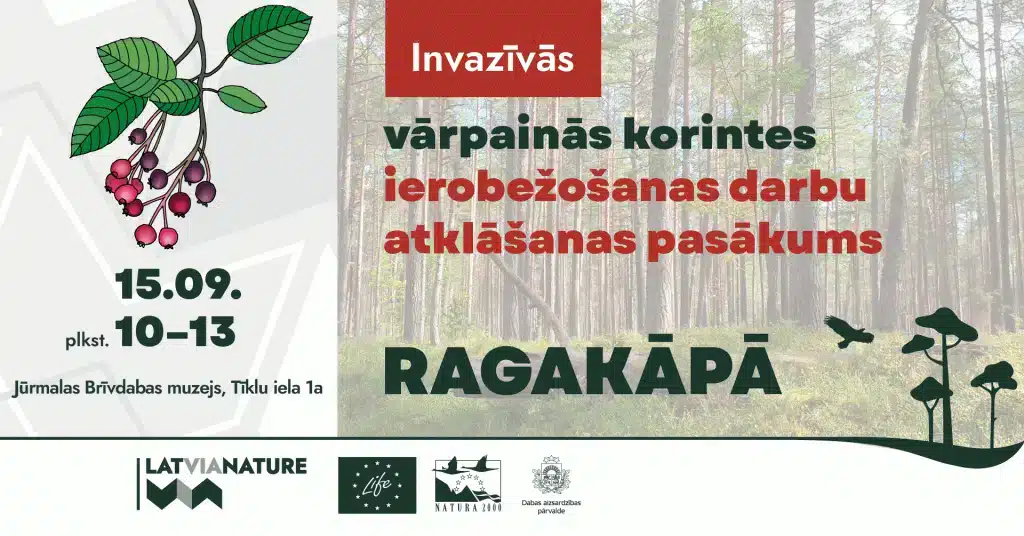
Experts outlined the planned control measures for dwarf serviceberry in the oldest and most biologically valuable part of Ragakāpa Nature Park, covering an area of 33 hectares. The work was planned for 2023–2026 as a part of the LatViaNature project. Following the presentation, members of the public had the opportunity to join the experts in a volunteer workday to help control dwarf serviceberry. Meeting point: Jūrmala Open-Air Museum, 1A Tīklu Street, Jūrmala.
The invasive alien species dwarf serviceberry (Amelanchier spicata) has spread throughout part of Ragakāpa Nature Park in Buļļuciems. As it spreads prolifically, it alters woodland structure, changes environmental conditions and affects soil composition. As a result, species characteristic of wooded coastal dunes disappear, and pine trees gradually lose their dominance. The open, light pine woodlands typical of coastal dunes may gradually develop into dense, overgrown stands that are difficult to walk through and have poor visibility. To preserve the area’s unique natural values, including the wooded coastal dunes habitat of European importance, controlling invasive alien species has been designated as a top-priority management measure in the approved Ragakāpa Nature Park Conservation Plan for 2019–2031.
The LatViaNature project will assess the effectiveness of various environmentally friendly methods for controlling dwarf serviceberry (Amelanchier spicata) under Latvian conditions at Ragakāpa Nature Park. The aim is to develop science-based guidelines for controlling this invasive alien species elsewhere in Latvia. The planned work includes:
- Uprooting shrubs and roots using hand tools – 19 ha (areas marked B on the map).
- Removing shrubs and roots using compact machinery – 14 ha (areas marked C on the map).
- Cutting down shrubs and precisely applying plant protection products to the stumps with a brush – in a restricted area of 0.08 ha (areas marked D on the map).
- Frequent strimming of dwarf serviceberry – on steep slopes and around veteran trees, covering 0.14 ha (areas marked A on the map).

The work will be carried out under the supervision of experts from Nature Conservation Agency of Latvia from September 2023 to February 2024. Experience shows that controlling invasive alien species is challenging and cannot be achieved in a single year. Further work will therefore continue during the autumn and winter months through to 2026, focusing on dwarf serviceberry stems missed during the initial work and on regrowth from shoots. The results will be monitored and assessed through to 2027. The work will be organised to minimise the impact on the dunes. Compact machinery will follow routes designated by experts. Piles of uprooted dwarf serviceberry shrubs will remain in the dunes temporarily. The work will also leave patches of exposed sand where the shrubs have been uprooted. Although these areas may look unusual, they provide habitats for rare species such as pasqueflower (Pulsatilla patens) and sand pink (Dianthus arenarius), while also helping to promote pine regeneration.
The LatViaNature project, funded by the European Commission’s LIFE Programme, is conducting largest scientific study in Latvia to date on the control of invasive alien species. The study evaluates control methods for five harmful invasive alien species at 13 pilot sites across Latvia, covering a total area of more than 100 hectares.


